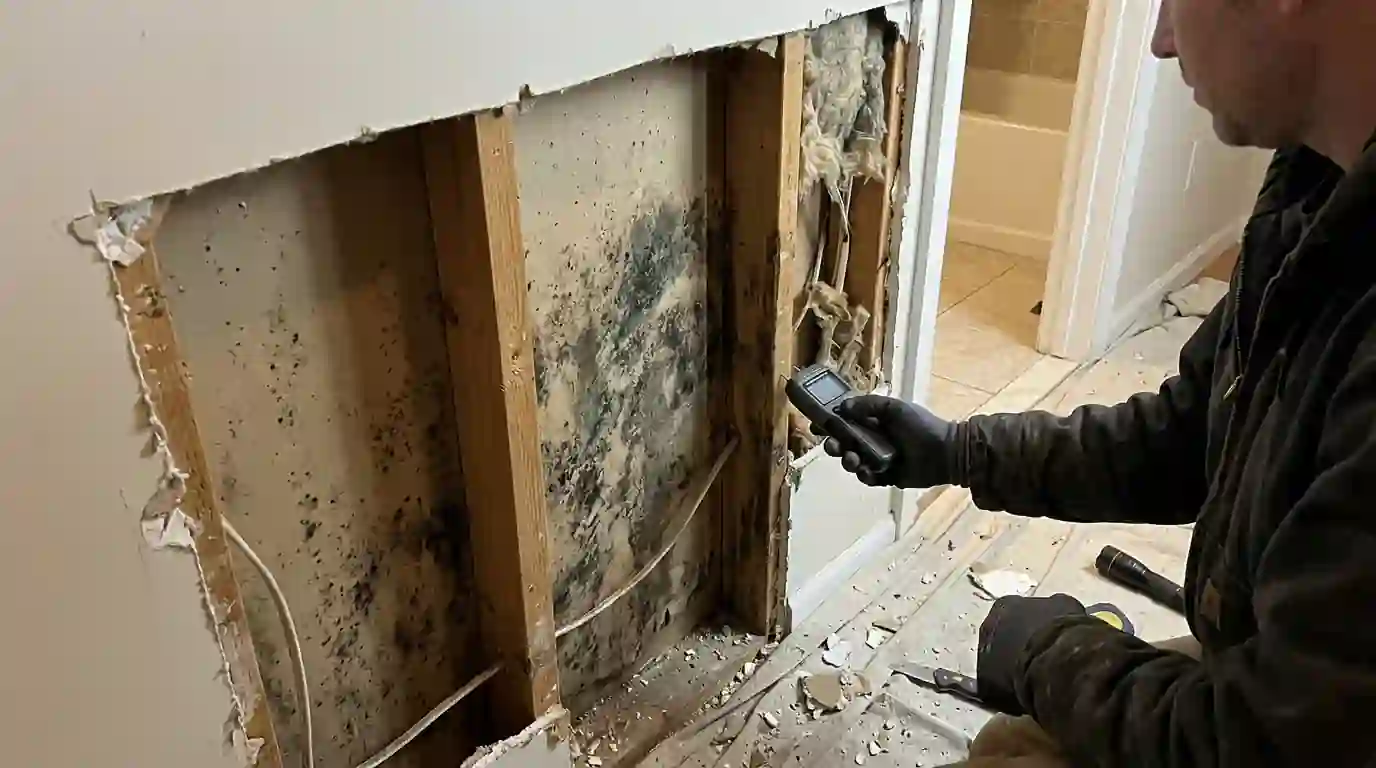
Quick answer
Floor mold in New York City usually sits in the carpet pad, under laminate or hardwood, and on the subfloor after a leak or flood, and water damage restoration runs from about $3.50 per square foot for clean water to about $7.50 for sewage on national figures. Carpet and pad that grew mold are removed; the subfloor is dried and cleaned or replaced.
Updated September 2026
Why floor mold hides so well
The surface of a carpet or a wood floor can look dry a day after a leak while the pad, the underside of the boards and the subfloor stay wet for weeks. That is where the growth starts, out of sight, and the first signs are a smell that will not leave, carpet that feels damp at the edges, or boards that cup and gap.
We read the floor with a meter in a grid, pull back the carpet or lift a few boards where the readings are high, and decide from what we find. The source comes first: a leak or flood still running under a floor will undo any cleanup. Then what grew is removed inside containment and the subfloor is dried to readings.
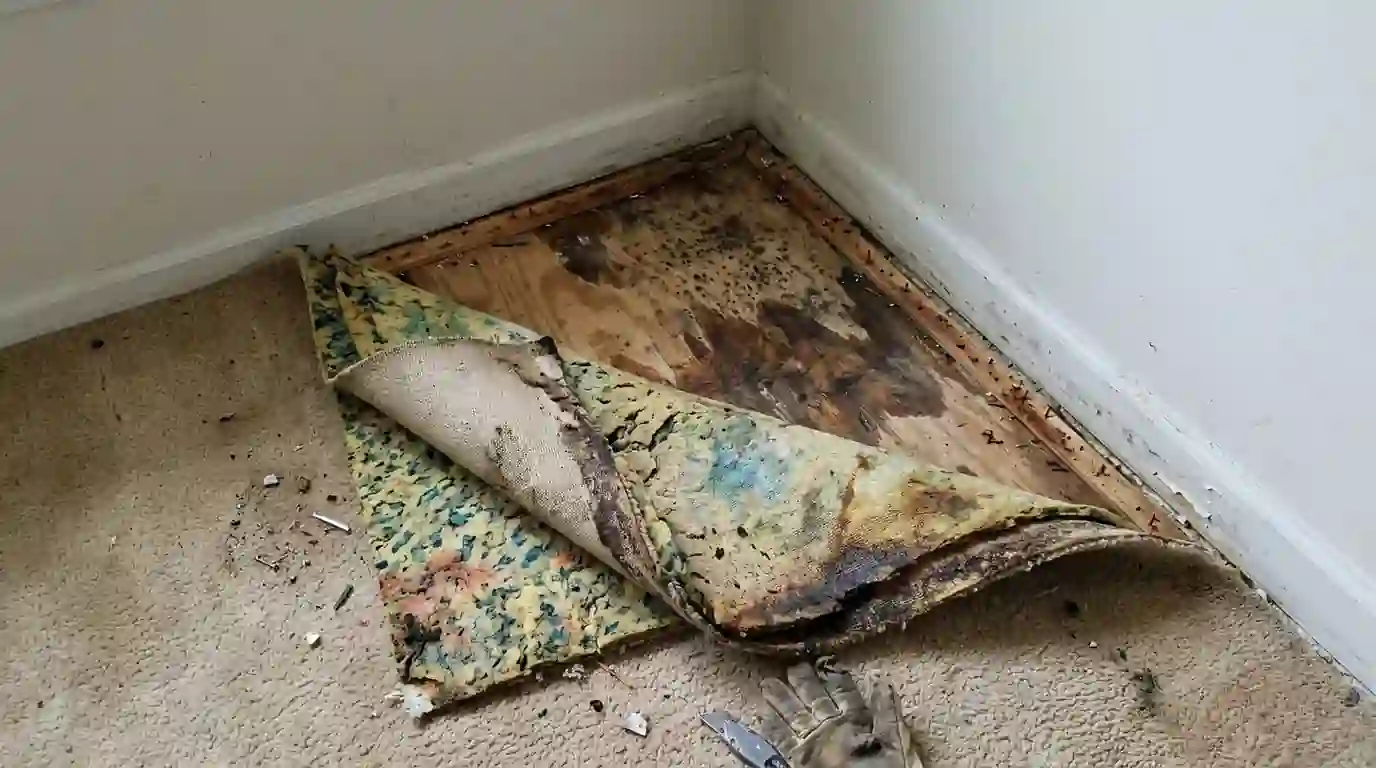
Clean and dry, or remove and replace
| Option | Clean and dry | Remove and replace |
|---|---|---|
| Carpet | Clean water caught fast, carpet only, no growth | Pad soaked, growth present, or gray or black water |
| Hardwood | Boards that dry flat and read dry | Cupped, buckled or blackened boards |
| Laminate and vinyl plank | Rarely; water sits trapped underneath | Usually, once water got under the planks |
| Subfloor | Sound panels that dry to readings | Swollen, delaminated or soft panels |
Carpet and pad
Carpet pad soaks up water like a sponge and holds it against the subfloor, so it is almost always the first thing to grow mold under a wet carpet. We pull the carpet back, check and cut out the pad, and read the subfloor. Carpet that got wet with clean water and was caught quickly can sometimes be dried and relaid over new pad; carpet with growth, or carpet soaked by a toilet or sewage backup, is removed. We bag everything inside containment so spores do not travel through the home.
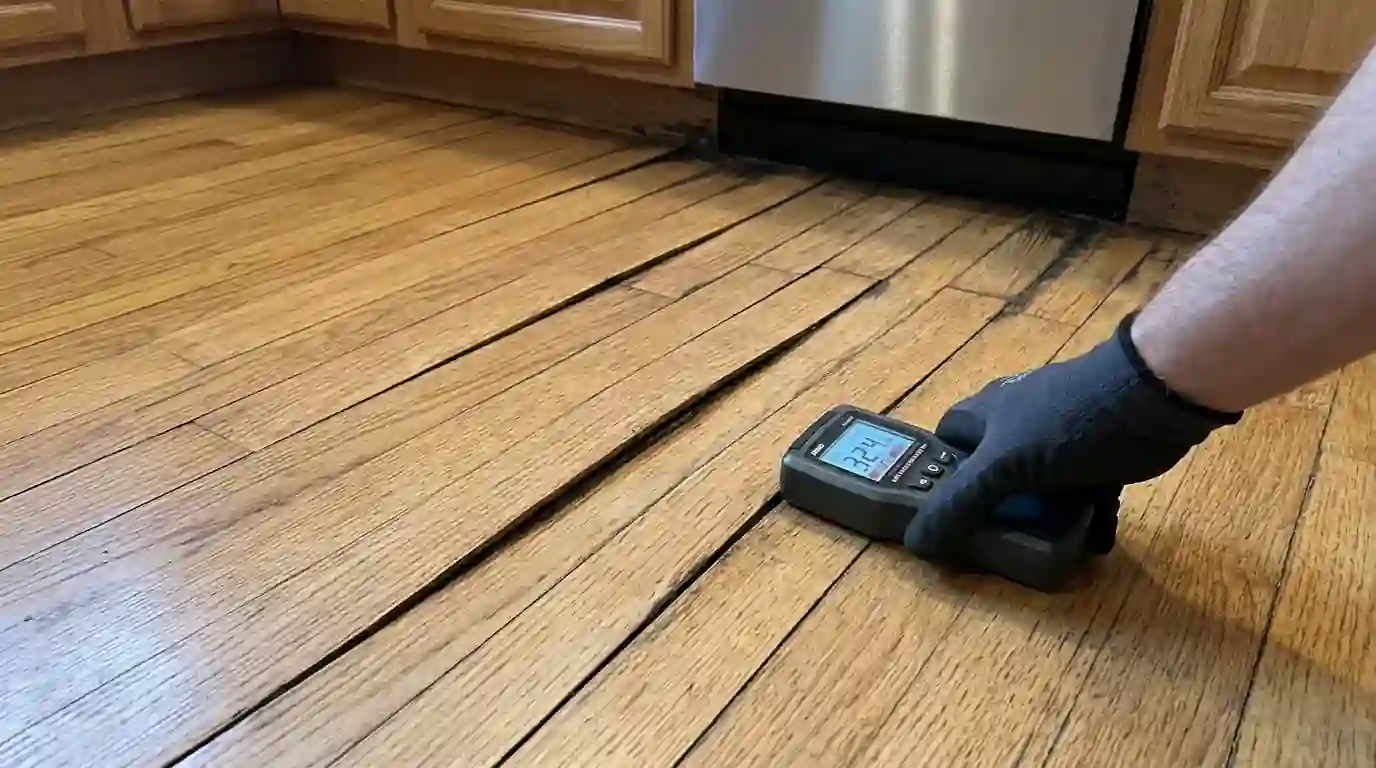
Hardwood and laminate
Solid hardwood can dry out if it is caught early, and we dry it in place with the moisture readings as the guide. Boards that have cupped hard, split or turned black at the edges usually come out. Laminate and vinyl plank are different: they sit on a thin underlay that traps water with nowhere to go, so once water gets under them, the planks nearly always come up so the underlay can be removed and the subfloor dried. We keep a few planks for matching the repair.
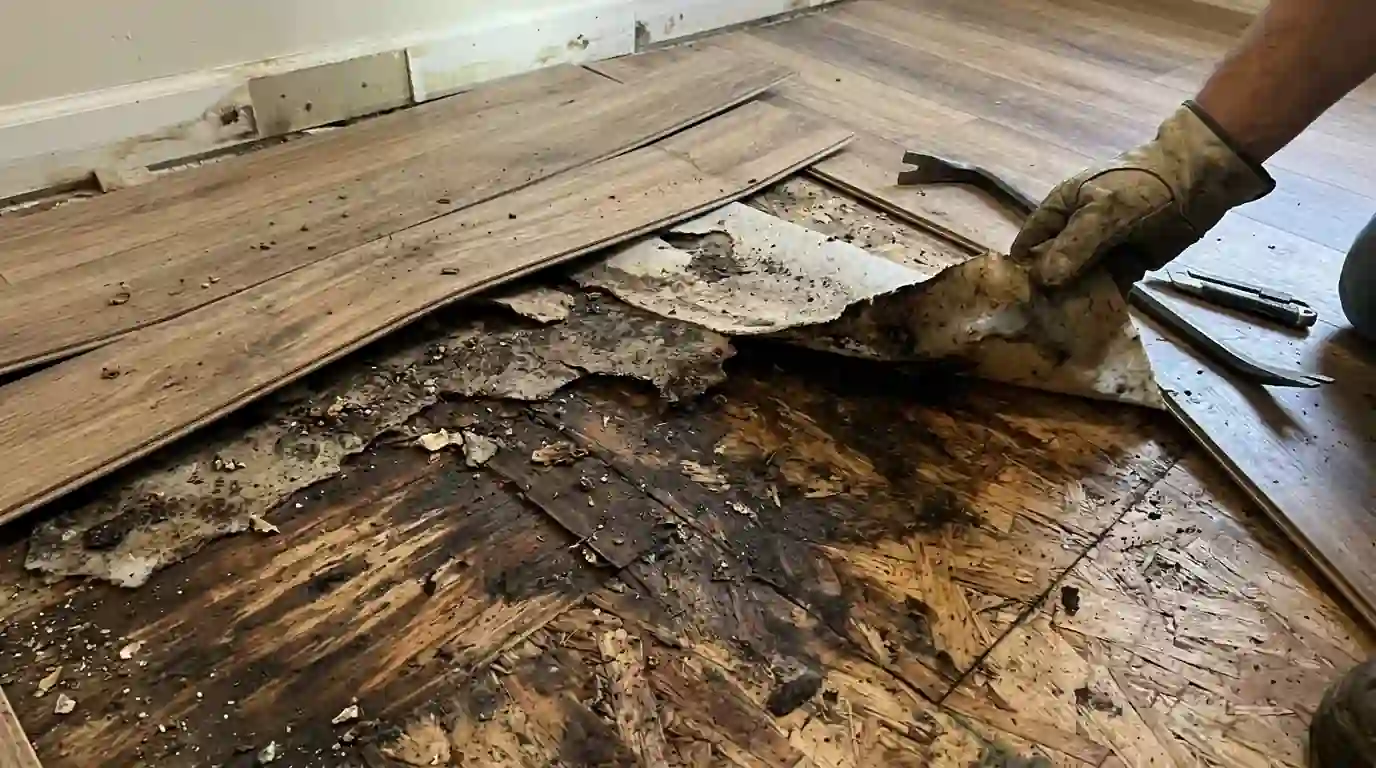
Subfloor and sleepers
Under the finish floor is plywood, particleboard or, on a basement slab, wood sleepers. Particleboard swells and crumbles when wet and is replaced. Plywood that dries flat and reads dry is cleaned and kept; plywood that has softened or delaminated is cut out. Sleepers on concrete trap moisture from the slab below, so we dry them and check whether the slab itself is the source before new flooring goes down. A slab that keeps reading wet needs its own fix, or the new floor will fail the same way.
What floor mold removal costs
We did not find a sourced national range for floor mold on its own. National figures for water damage restoration run about $3.50 per square foot for clean water, $5.25 for gray water and $7.50 for sewage, which is a fair guide to how the water source changes the price.
Area affected
Square footage of flooring that grew.
Flooring type
Carpet, hardwood, laminate or tile.
Subfloor damage
Replacing particleboard or plywood panels.
Water category
Clean, gray or sewage water changes what can be kept.
New flooring
Priced separately once the floor is dry.
New York conditions
Why slab floors in older suburbs stay wet
Levittown in Nassau County was built as 17,447 slab-on-grade houses between 1947 and 1951, with no vapor barrier under the slab and copper radiant heating pipes set in the concrete. Those pipes corroded over time, and leaks often soaked into the ground unnoticed. On slab floors like these, carpet and wood flooring sit on concrete that can draw moisture from below, so we read the slab as well as the flooring before deciding what comes up.
How a floor job runs
Readings first, then removal, then drying.
We read the floor in a grid
Meter readings show how far the water spread.
We stop the source
Leak, appliance line or flood path fixed first.
We seal the room
Containment and negative air before pulling anything.
We remove what grew
Pad, carpet, planks and damaged subfloor bagged out.
We clean and dry
HEPA cleaning and dehumidifiers until readings are dry.
We prepare for new flooring
Subfloor repaired and ready for your floor installer or ours.
Call (332) 234-9326A person answers, day or night.
How long a floor takes to dry
Removal takes a day or less in most rooms. Drying is the longer part, especially for a subfloor or a slab under sleepers, and it runs until the meter says dry rather than to a set number of days. We check the readings on each visit and tell you when the floor is ready for new material.
Questions about carpet and floor mold removal
Carpet pad with growth is removed. The carpet itself is kept only if it got clean water and was dried quickly.
The pad or subfloor underneath is still wet or has grown mold.
Often, if dried early. Cupped or blackened boards usually come out.
Usually, because water trapped underneath has no way to dry.
We prepare the subfloor and can put down replacement flooring, or hand off to your installer.
Right away. Drying within a day or two often saves the floor.
Related jobs we handle
Ceiling Mold Removal
Stains from the unit above or the roof, opened, dried and rebuilt.
Wall Mold Removal
Opening walls in the right place and cutting only what the mold reached.
Kitchen Mold Removal
Sink bases, appliance line leaks and the wall behind the backsplash.
Attic Mold Removal
Roof sheathing and insulation cleaned or replaced, and the ventilation fixed.
Floor smells musty or feels soft?
Call now. We answer 24/7 and check what is wet before anything comes up.
Answered 24 hours a day, 7 days a week