Quick answer
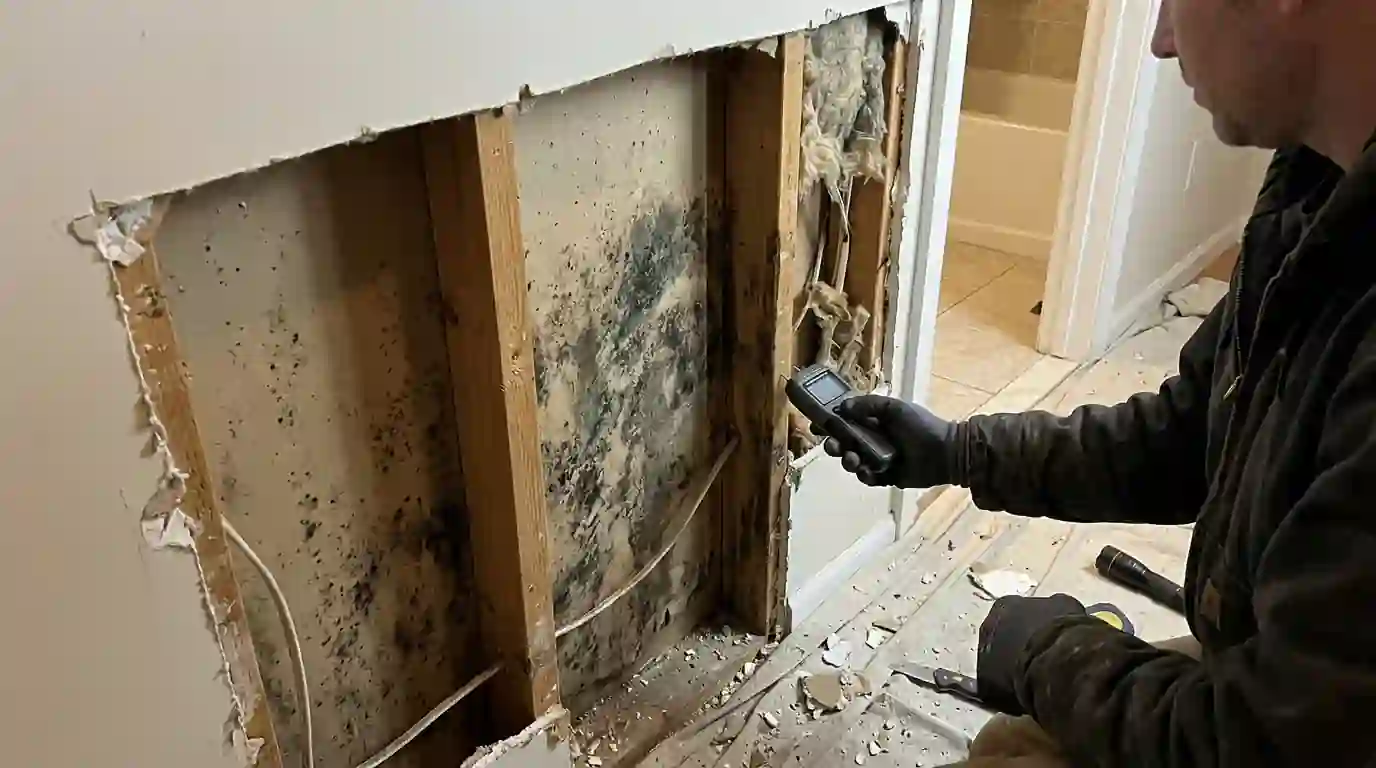
Kitchen mold in New York City is usually hidden under the sink base, behind the dishwasher or refrigerator, or in the wall behind the backsplash, fed by slow drips from traps, supply lines and appliance hoses. National guides put kitchen mold removal at $1,200 to $10,000, depending mostly on whether cabinets and wall board have to come out.
Updated September 2026
Why kitchen mold stays hidden
A sink trap that weeps a few drops an hour, a dishwasher drain hose with a hairline crack or a refrigerator ice-maker line that leaks at the valve never makes a puddle anyone sees. The water soaks into the particleboard floor of the sink base, runs under the cabinets and wicks up the wall behind them. By the time the cabinet floor swells or a musty smell reaches the room, the back of the cabinets and the wall board have been wet for months.
We read the cabinets, floor and wall with a meter, pull the sink base or appliance where the readings point, and remove the materials that grew inside containment. The cavity is dried, the leak is repaired by a plumber, and the cabinets go back, or new ones go in where the originals cannot be saved, through our repair work.
Under-sink cabinet bases
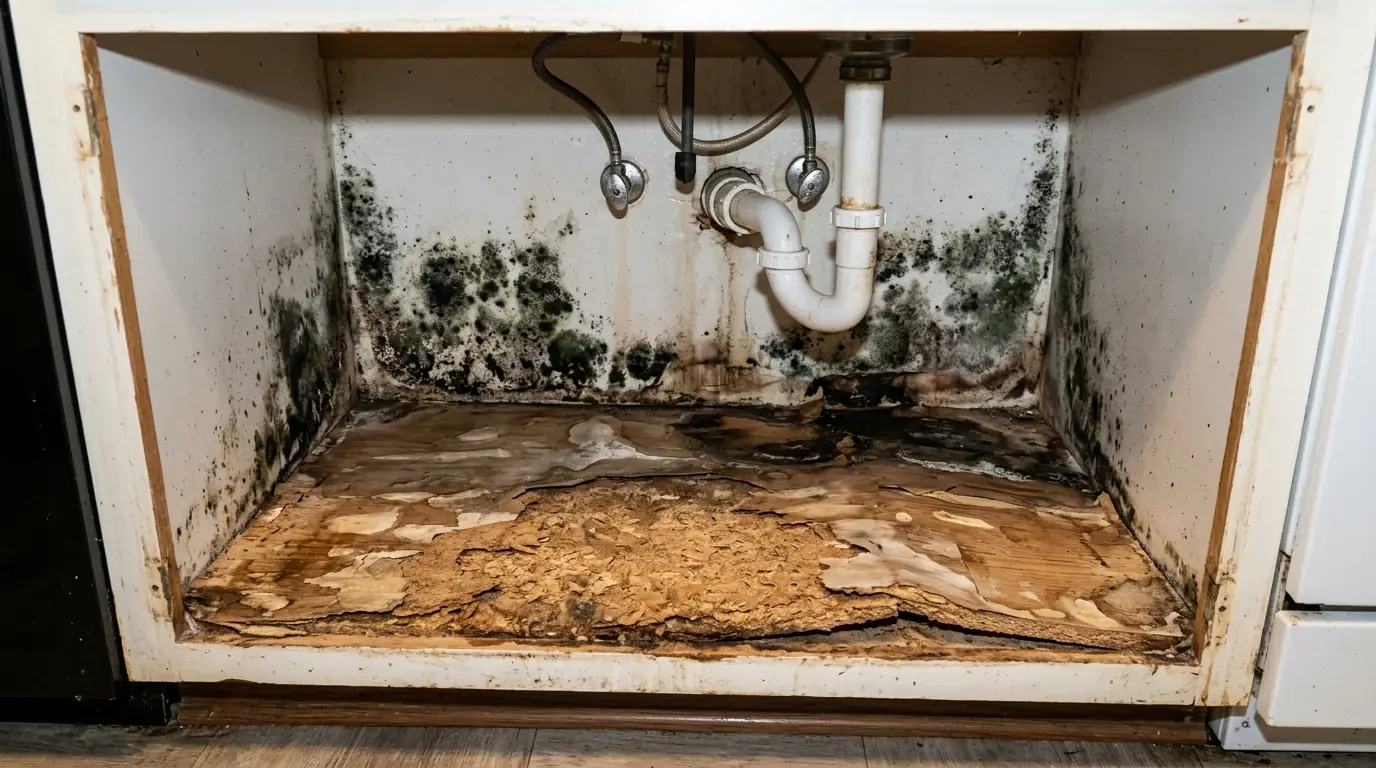
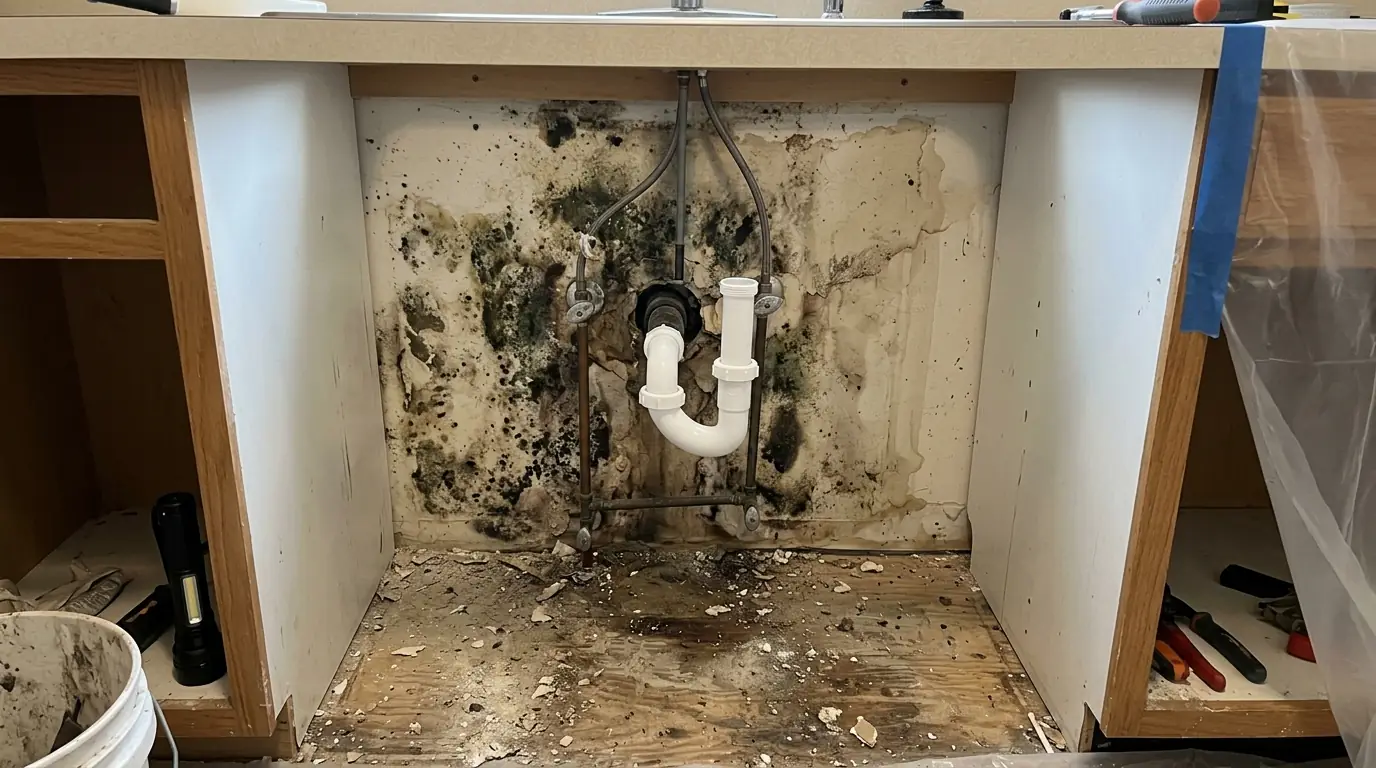
The sink base is the most common place for kitchen mold. Traps, disposer connections, faucet supply lines and the seal around the sink itself all leak slowly. We empty the cabinet, read the floor panel and back wall, and remove particleboard that has grown mold, which usually cannot be cleaned. The wall behind is opened if it reads wet, dried and cleaned, and the cabinet base is rebuilt or replaced once the plumber has fixed the leak and the new connection has run dry for a day.
Dishwasher and refrigerator line leaks
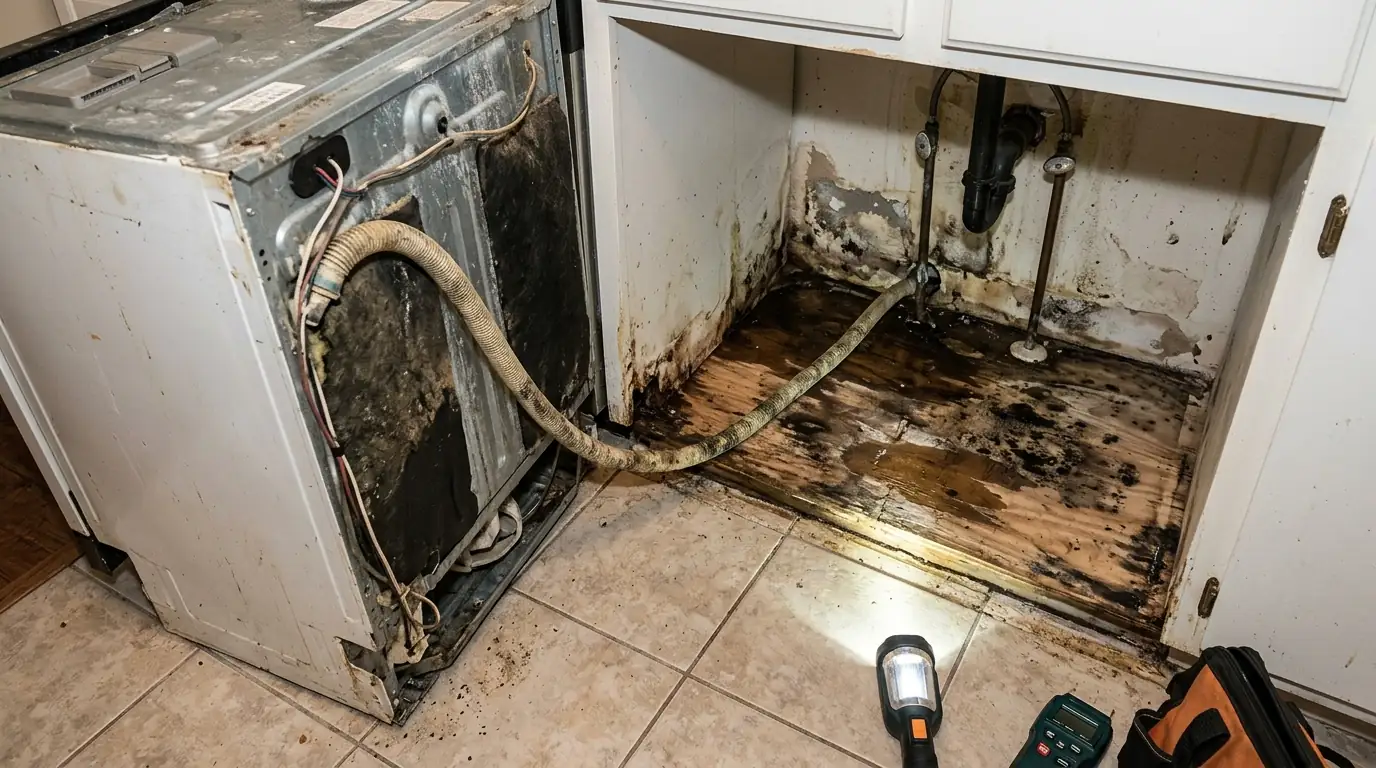
Dishwasher supply and drain lines and refrigerator ice-maker and water lines leak where nobody looks: behind and under the appliance. The water runs under the adjacent cabinets and the flooring. We pull the appliance, read the floor and the wall behind it, remove flooring and board that grew, and dry the area with the appliance out of the way until the readings are dry. Braided replacement lines and a drip pan under the refrigerator are small, inexpensive fixes that prevent a repeat of the same leak.
Backsplash and window walls
The wall behind the counter can grow mold without any plumbing leak. A window over the sink that sweats all winter, a facade leak, or steam from cooking with no working range hood can wet the wall behind the backsplash tile. We check with a meter, open the wall from the least visible spot where we can, remove what grew and dry it. Then we look at the ventilation, because a hood that recirculates or barely pulls air leaves the moisture in the kitchen.
What kitchen mold removal costs
National guides put kitchen mold removal at $1,200 to $10,000. A single sink base sits at the low end; jobs that take out a run of cabinets, flooring and wall board sit toward the top.
Cabinets affected
One sink base or a whole run.
Flooring
Replacing planks or tile around appliances.
Wall board
Opening and rebuilding the wall behind.
Countertops
Removing and resetting stone or laminate tops.
Appliances
Pulling and reinstalling the dishwasher or fridge.
Signs of hidden kitchen mold
A swollen sink base floor
Particleboard that bubbles or softens has been wet for a long time.
Musty smell when the cabinet opens
The smell is strongest where the growth is.
Buckled flooring near the dishwasher
Water from the drain or supply line has spread under the floor.
Stains on the wall behind the fridge
The ice-maker line or drain pan may be leaking.
Spots on the backsplash wall
Condensation or a window leak behind the counter.
A water bill that crept up
A running leak can show on the bill before anywhere else.
New York conditions
Kitchen leaks in city apartment buildings
About 69 percent of occupied homes in New York City are rented, and in a multi-family building a slow leak under one kitchen sink can reach the cabinets and ceiling of the apartment below. When mold from a leak like that is reported, HPD classes the violation by size: under 10 square feet is Class A, 10 to 30 square feet is Class B, and 30 square feet or more is Class C with 24 hours to correct. Catching a sink base leak early keeps it small.
What you can check, and when to call
What you can safely do
- Look under the sink with a flashlight for drips, stains and swelling
- Pull the kick plate under the dishwasher and look for water
- Replace old rubber appliance hoses with braided lines
Where it needs us
- A cabinet floor that is soft, swollen or stained
- Mold on the wall behind cabinets or appliances
- Buckled flooring near the sink or dishwasher
- A smell that stays after cleaning the cabinet
How a kitchen job runs
Readings first, then cabinets out, then dry.
We read the kitchen
Cabinets, floor and walls near the sink and appliances.
We protect the room
Counters, floors and nearby cabinets covered.
We pull what is affected
Sink base, appliances or panels where readings point.
We remove what grew
Particleboard, flooring and wall board bagged inside containment.
We dry and hand off the leak
Readings until dry; the plumber fixes the source.
We put it back
Cabinets reset or replaced, appliances reinstalled.
Call (332) 234-9326A person answers, day or night.
Questions about kitchen mold removal
Particleboard that grew mold is usually replaced. Solid wood can sometimes be cleaned.
Only when the cabinet under it has to come out. We plan it to protect stone tops.
A plumber repairs it; we coordinate so the timing works.
Usually, apart from the section that is sealed off.
Braided supply lines, a drip pan under the fridge and a working range hood help.
We check the ceiling below and dry it too when the water got there.
Related jobs we handle
Attic Mold Removal
Roof sheathing and insulation cleaned or replaced, and the ventilation fixed.
Bathroom Mold Removal
Ceilings over the shower, walls behind tile and floors under the toilet.
Basement Mold Removal
Foundation walls, framing and finished basements dried and cleared.
Crawl Space Mold Removal
Joists, sills and the ground cover under additions and older houses.
Musty smell under the kitchen sink?
Call now. We answer 24/7 and find the leak before we pull anything.
Answered 24 hours a day, 7 days a week