Answering 24/7 in New York, NY
Mold removal and water damage cleanup in New York, NY
Mold on the ceiling, a musty closet, or a basement that took on water? We find the moisture, seal off the room, remove what the mold reached and dry the building so it stays gone.
- Answered 24 hours, 7 days
- Containment and HEPA air on removals
- Apartments, houses and businesses
What to do about mold in a New York home or building
Quick answer
Mold in New York City is handled by size: under 10 square feet, the leak gets fixed and the growth is cleaned or cut out with HEPA vacuuming; over 10 square feet in a building of 10 or more units, city rules require one company to assess it and a separate company to remove it. Either way, we start in the same place, by finding the water.
Air conditioners, ducted systems and dehumidifiers we clean and set up
- Friedrich
- GE Zoneline
- Amana
- Islandaire
- Carrier
- Trane
- Lennox
- Mitsubishi Electric
- Daikin
- LG
- Fujitsu
- Aprilaire
- Santa Fe
- AlorAir
Mold grows inside air conditioners as readily as on walls. We open and clean through-wall and PTAC units from Friedrich, GE Zoneline, Amana and Islandaire, clean coils and ducts on Carrier and Trane systems, and set up basement dehumidifiers from Santa Fe and Aprilaire. See HVAC and duct mold removal and dehumidifier installation.
Start here
What are you seeing?
Pick what matches and we will point you to the right job.
A musty smell usually means hidden growth
Look at carpet pads, the backs of walls, closets on cold outside walls and air conditioners.
Musty odor removalMold inspection
Call (332) 234-9326A growing stain means water is still arriving
It usually starts in the unit above, a riser or the roof. Stop the source before opening the ceiling.
Hidden leak detectionCeiling mold removal
Call (332) 234-9326Dark growth at floor level means long-wet drywall
A slow leak or old flood water wicked up the board. It gets cut out, not scrubbed.
Black mold removalWall mold removal
Call (332) 234-9326Standing water gives you a day or two
Pump it out, pull soaked materials and dry it. Water from a drain counts as sewage.
Flooded basement cleanupSewage backup cleanup
Call (332) 234-9326Winter window mold is condensation
Cold glass meets warm, moist air. Clean it, then bring the room humidity down.
Condensation moldWinter mold guide
Call (332) 234-9326The source and the mold both get fixed
The class sets the deadline, from 90 days down to 24 hours.
HPD violation workLocal Law 55 guide
Call (332) 234-9326Active water comes first
Stop it, protect belongings and start drying today, before anything grows.
Water damage restorationLeak from upstairs guide
Call (332) 234-9326All 29 services
What we remove, test, dry and rebuild
Each page covers one job: what it involves, typical national costs, and how it goes in New York buildings. Not sure which you need? Start with the mold inspection page or call us.
Mold remediation
Whole-job removal inside sealed containment, sized to the building: a single co-op unit, a restaurant basement or a floor of offices.
Mold by room
Mold follows water, so each room has its own usual source. These pages cover what we open up, what we remove and what we fix so it stays gone.
Inspection and testing
Finding the moisture, sampling the air and surfaces, and reading the results before anyone cuts into a wall.
Water damage and moisture
Mold starts with water. Extraction, drying and humidity control within the first 24 to 48 hours stop most mold jobs before they exist.
Air, odor and rebuild
What comes after removal: clean ducts and units, a room that no longer smells, belongings you can keep and walls put back.
Local conditions
Why mold is so common in New York buildings
More than half of the city's housing units are in buildings put up before 1947, and four in five are older than 1974. A slow riser leak in a prewar building can wet three apartments before anyone sees a stain, which is why we trace the water damage before we quote the mold.
Storms have changed too. City sewers are built for 1.5 to 1.75 inches of rain an hour; Ida dropped 3.15 on Central Park in one hour in 2021. About 60 percent of the city runs on combined sewers, so heavy rain can push sewage up through basement floor drains that have no backwater valve. A flooded basement left wet for more than a day or two becomes a mold job, and a sewer backup needs disinfection too.
Winter brings the other kind of moisture. January nights at Central Park average in the upper 20s, cold enough to sweat single-pane glass and uninsulated exterior walls in a steam-heated apartment. The black line on the caulk is condensation mold, and it keeps coming back until the moisture stops.
The rules matter too. Local Law 55 requires owners of buildings with three or more apartments to inspect every unit each year for mold and fix the cause, and in buildings with 10 or more units, mold over 10 square feet has to be assessed and removed by two independent companies. We tell you which side of that line you are on before work starts, and our HPD violation work is built around it.
What happens after you call
The order below is the same for a bathroom ceiling in a Midtown studio and a flooded basement in Queens. Only the size changes.
We answer and ask about the water
Where is it, how long has it been wet, and is it still leaking? The answers decide whether the first visit is drying or removal.
We find the moisture
Moisture meters and a thermal camera show how far the water went, so walls get opened in the right place.
We seal the work area
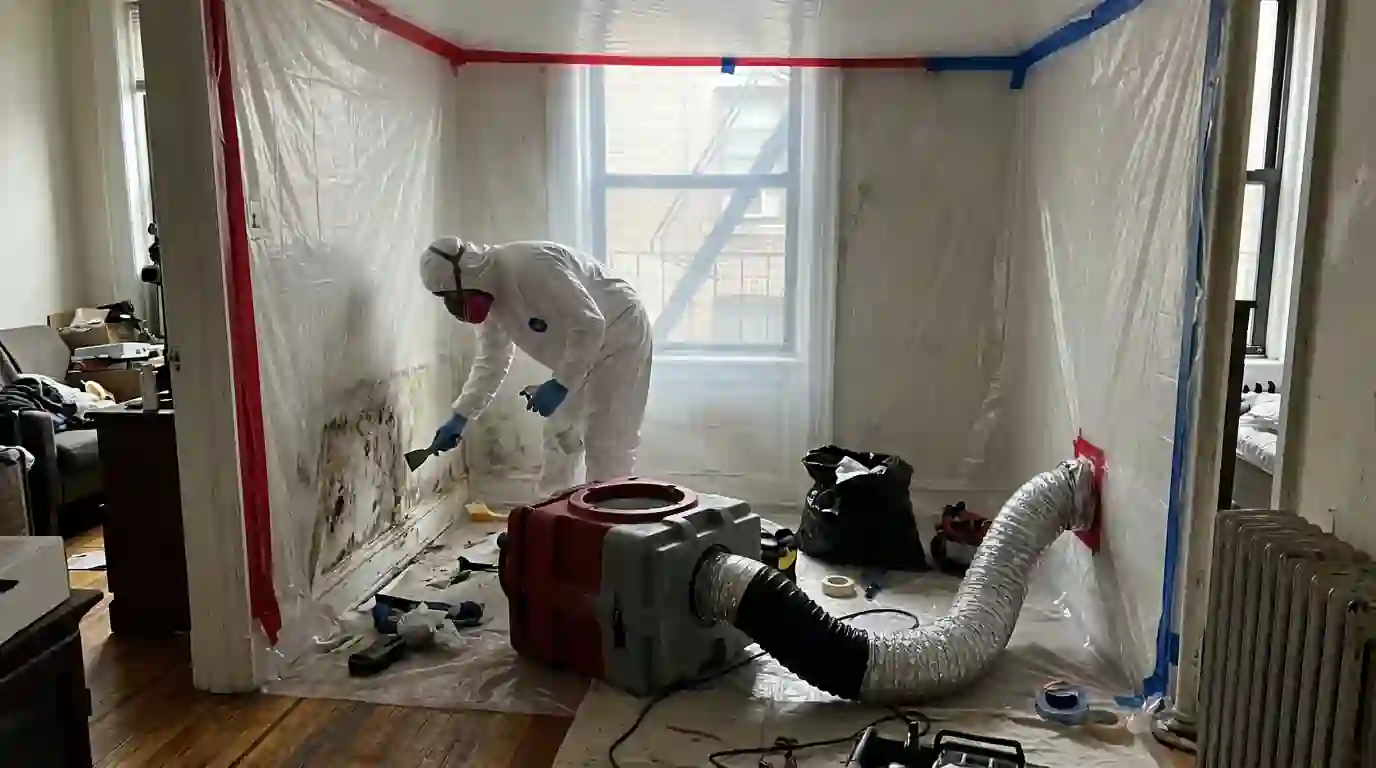
Plastic walls with a zipper door, covered vents and a HEPA air scrubber keep spores inside the room while the work happens.
We remove what the mold reached
Moldy drywall, insulation and carpet are cut out and bagged. Framing and concrete are cleaned, sanded or treated.
We clean and dry
HEPA vacuuming, damp wiping and dehumidifiers bring the room back to dry readings before anything is closed up.
We check, then close up
Final readings come first. When your job needs an independent assessor, they clear it before we rebuild the wall.
Call (332) 234-9326A person answers, day or night.
Coverage
Where we work
The Ace Mold Restoration office is in Midtown, on 6th Avenue, and we cover all five boroughs from there, starting with Manhattan. Brooklyn alone holds about 30 percent of the city's housing units, Queens took the worst of the Ida basement flooding, Staten Island's east shore took a 14-foot surge in Sandy, and in the Bronx we handle the same riser leaks and winter condensation we see in Manhattan.
Past the city line we take calls in Nassau County, Westchester County and Yonkers, and across the Hudson in Hudson County, Hoboken, Jersey City and Bergen County. The coverage page explains how far we go and where coverage ends.
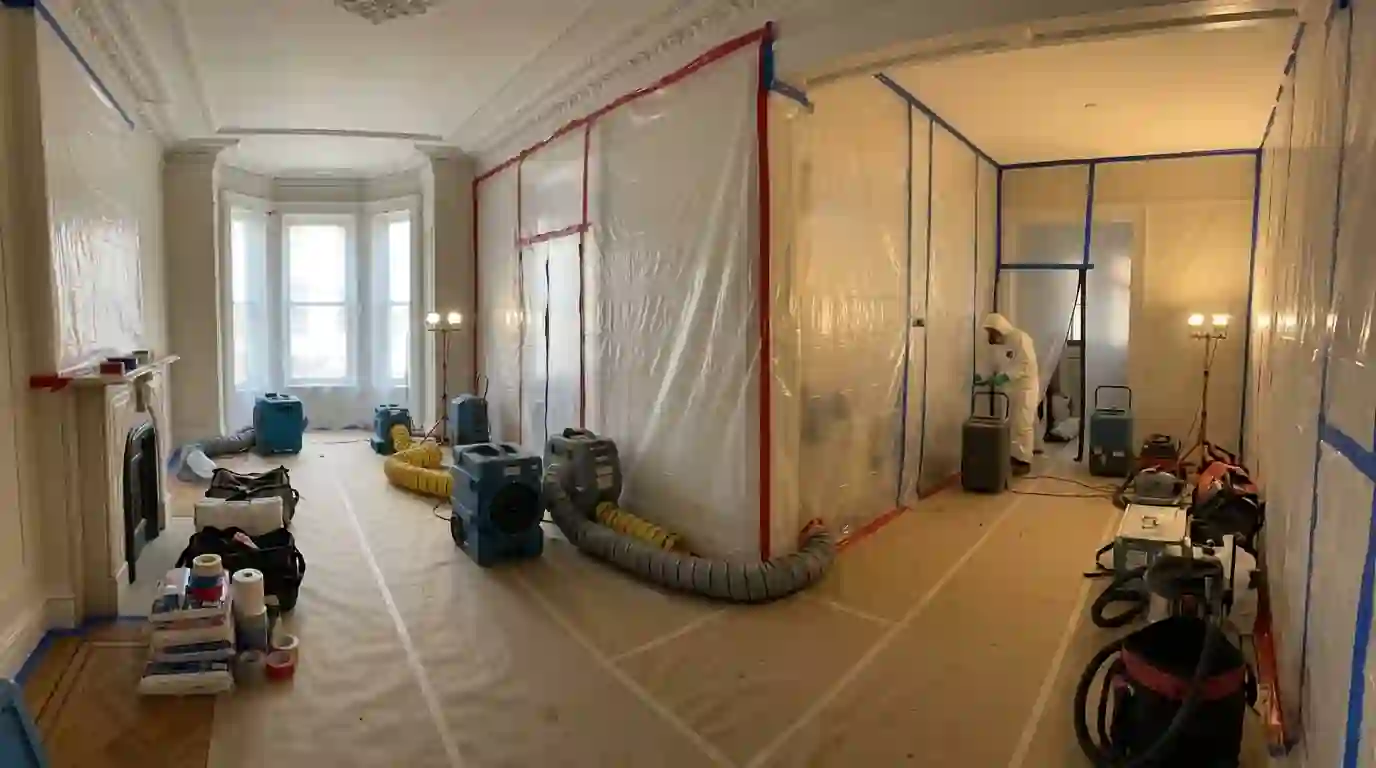
Containment on a parlor floor keeps dust and spores in one room while the rest of the home stays in use.
Talk to us nowLearn
Read before you call
Plain answers on cost, city rules and what to do first. More in all guides.
What Mold Remediation Costs in New York, NY
National ranges and what drives the price in city buildings.
Mold in a NYC Apartment: Local Law 55 Explained
What owners must do, and how HPD classes violations.
Flooded Basement in New York: The First 48 Hours
Hour-by-hour steps after a basement floods.
Straight answers
Questions New Yorkers ask us about mold
Seven we hear every week. Anything else, call and ask.
We answer 24 hours a day and give you a real arrival window on the phone. Active water goes ahead of dry mold.
In most rentals, yes. Local Law 55 puts mold and the leak behind it on the building owner, and HPD can write a violation when a tenant reports it through 311. We work for owners, managers and tenants alike.
Not always. Testing earns its cost when you smell mold but cannot find it, or when a larger building needs an assessment first.
National planning figures put a typical remediation at $1,223 to $3,757 and whole-house jobs at $10,000 to $30,000. Access, containment size and how much material comes out move the number most.
Usually. The work area is sealed under negative air, so the rest of the home stays usable.
Bleach lightens stains on tile but does not fix mold in drywall, wood or insulation. Porous material with growth gets cut out.
Yes, in Hudson County and Bergen County, including Jersey City. The coverage page shows where it stops.
Found mold, or water where it should not be?
Call now. A person answers, day or night, and tells you what we can do and when.
Answered 24 hours a day, 7 days a week